Interpreting Sickle Cell Data for Better Clinical Decisions
For clinicians managing patients with sickle cell disease, one of the most persistent challenges has been the gap between what happens inside the consultation room and what happens in the twenty-three hours before a patient walks through the door.
Traditional clinical encounters rely heavily on patient recall. How was your pain this week? Did you stay hydrated? Did you notice anything unusual? These are important questions, but they depend on memory that is often incomplete, shaped by the most recent events rather than the full picture. For a condition as variable and unpredictable as sickle cell disease, that gap can be significant.

The Value of Continuous Data
Continuous health monitoring changes this equation. When patients wear devices that track biometric data throughout the day — heart rate variability, oxygen saturation, skin temperature, and activity levels — clinicians gain access to a longitudinal record that captures fluctuations that might otherwise go unnoticed. This data doesn't replace clinical examination. It supplements it with context.
For example, a patient presenting with a moderately elevated heart rate during a clinical visit might normally prompt a brief investigation before being attributed to anxiety or recent physical activity. With continuous monitoring data, a clinician can see whether that elevation began suddenly or developed gradually over several days, whether it coincided with changes in oxygen saturation or temperature, and whether it follows a pattern that has preceded crisis episodes in the past. That context shapes the clinical response.
From Data to Decision
Interpreting patient-generated health data requires a framework. Not every fluctuation in biometric readings is clinically significant, and over-interpreting minor variations can lead to unnecessary anxiety for patients and inefficient use of clinical resources. The key is establishing individual baselines.
Because sickle cell disease presents differently across patients, population-level reference ranges are less useful than personal baselines. A resting heart rate that is elevated for one patient may be entirely normal for another. Monitoring platforms that establish personal baselines over time allow clinicians to identify meaningful deviations rather than reacting to absolute values.
When deviations from baseline are identified — particularly when multiple biometric parameters shift simultaneously — the clinical significance increases. A convergence of rising heart rate, falling oxygen saturation, and elevated skin temperature occurring together is more informative than any single measurement in isolation.
Practical Application in Clinic
Clinicians who have integrated continuous monitoring data into their practice report that appointments become more targeted. Rather than spending significant time reconstructing what happened over the past weeks from patient recall, the data provides a starting point. Conversations shift from retrospective reporting to prospective planning.
Patients arrive with a record of their health over the past weeks. Clinicians can identify patterns, flag periods of concern, and adjust care plans based on evidence rather than estimates. For patients with sickle cell disease, this approach supports more personalised management — which, given the variability of the condition, is precisely what is needed.
The goal is not to replace clinical judgment with algorithms. It is to give clinical judgment better information to work with. When clinicians and patients both have access to the same objective data, the conversation changes. It becomes a collaboration rather than a consultation.
Related Article

Improving Patient Outcomes Through Data-Driven Sickle Cell Management
This study explores how integrating real-world patient data with clinical practice can help physicians anticipate complications earlier and personalize treatment plans.
Continue Reading →
Enhancing Sickle Cell Care With Continuous Clinical Insights
This research focuses on how ongoing data collection and analysis can support doctors in tracking disease patterns, identifying risk factors, and delivering more proactive care.
Continue Reading →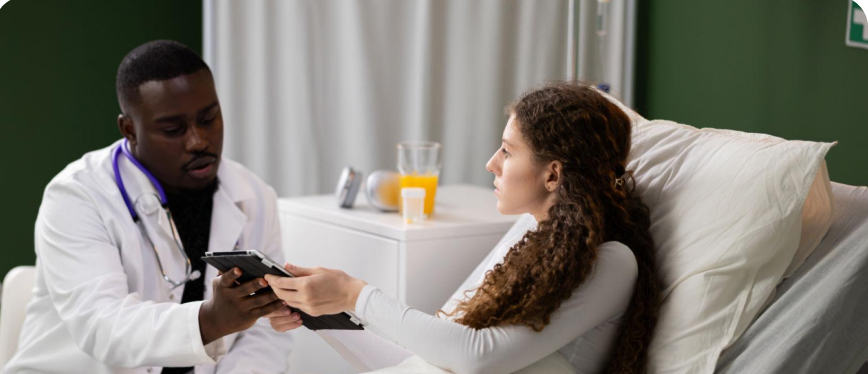
From fear to data — how STATRA changed how Fatima manages her sickle cell.
What once felt like uncertainty and constant worry has become clarity and control — STATRA helps Fatima track her health parameters and stay ahead of every crisis.
Continue Reading →